
AI in SEO: The Ultimate 2026 Guide for Smarter Rankings
Introduction:
SEO Has Entered the Intelligence Era
Search Engine Optimization is no longer just about inserting keywords and building backlinks. The way search engines rank websites has fundamentally changed.
Today, AI in SEO is shaping how content is discovered, evaluated, and ranked. Search engines use artificial intelligence to understand context, intent, behavior, and authority — not just words on a page.
If you are still relying only on traditional SEO tactics, you are competing in yesterday’s system.
For example:
“one niche blog that relied only on keyword stuffing struggled to rank for months. After shifting to AI-based keyword clustering and intent-focused content, the same blog started ranking on page one within 6–8 weeks. This shows how modern SEO now depends on intelligent strategy rather than outdated methods.”
Artificial intelligence now helps with:
- Keyword research
- Content creation
- Competitor analysis
- Technical audits
- Ranking predictions
- Search intent understanding
This guide explains everything you need to know — clearly and practically — so you can build a future-proof SEO strategy.
Note:
“Whether you are targeting the United State(US), United Kingdom(UK), Canada, or India, this is your complete roadmap.”
Why AI in SEO Matters More Than Ever
Search engines are no longer simple algorithms. They are intelligent systems trained to interpret language like humans.
1. Search Engines Are AI-Driven
Google uses multiple AI systems such as:
- RankBrain
- BERT
- MUM
- Helpful Content System
These systems analyze:
- Search intent
- Context
- Semantic meaning
- User satisfaction signals
Note:
“This means exact keyword repetition is no longer enough. Content must answer real questions clearly and deeply.”
For instance, a website publishing only short keyword-focused blogs saw minimal traffic growth. After expanding articles with FAQs, clear explanations, and structured headings, average ranking improved significantly within two months. Helpful content signals made the difference.
2. Search Behavior Has Changed
Users now search conversationally:
- What is AI in SEO?
- How to use AI in SEO for beginners?
- Best AI tools for SEO in 2026?
Voice search and AI assistants are increasing globally. Optimization must reflect this shift.
A digital marketing blog that optimized content for conversational queries and added FAQ sections saw improved impressions in Google Search Console within weeks. Long-tail traffic increased without additional backlinks.
3. Competition Is Intense
Millions of blog posts are published every day. Without smart data analysis, it is difficult to identify ranking opportunities.
AI helps marketers:
- Detect content gaps
- Identify low-competition keywords
- Understand ranking patterns
- Predict traffic potential
For example: “using AI competitor analysis tools, one blogger discovered multiple low-competition long-tail keywords ignored by competitors. Publishing optimized articles on those topics brought steady organic traffic growth over three months.”
What Is AI in SEO?
AI in SEO refers to the use of artificial intelligence technologies to improve search engine optimization (SEO) processes.
It includes:
- Machine learning for ranking analysis
- Natural language processing (NLP) for content optimization
- Automation tools for technical SEO
- Predictive analytics for performance forecasting
In simple terms:
“AI in SEO means using intelligent tools to make smarter SEO decisions.”
A practical example:
“Manual keyword research that previously took 3–4 hours can now be completed in under 30 minutes using AI-powered tools while also discovering related topic clusters.”
SEO vs AI SEO: What’s the Difference?
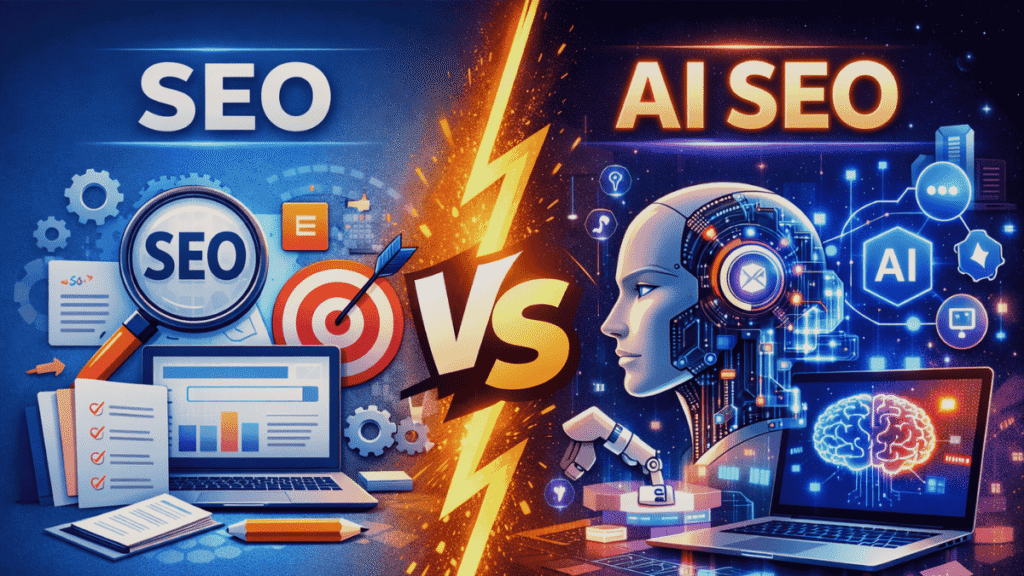
Traditional SEO relies heavily on manual research and fixed strategies. AI SEO uses automation and data intelligence.
Traditional SEO vs AI SEO comparison:
| Traditional SEO | AI SEO |
| Manual keyword lists | AI-generated keyword clusters |
| Basic SERP analysis | Deep intent modeling |
| Static optimization | Dynamic updates |
| Time-consuming audits | Automated site diagnostics |
| Limited scalability | High scalability |
Note:
“AI does not replace SEO. It enhances it.”
Many agencies now combine human strategy with AI tools to speed up optimization while maintaining content quality and originality.
Core Components of AI in SEO
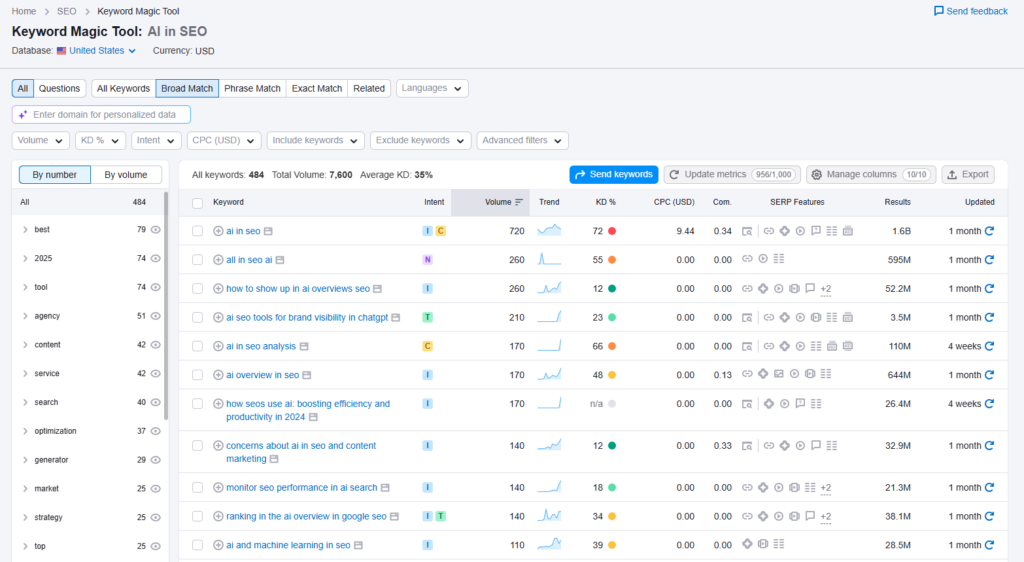
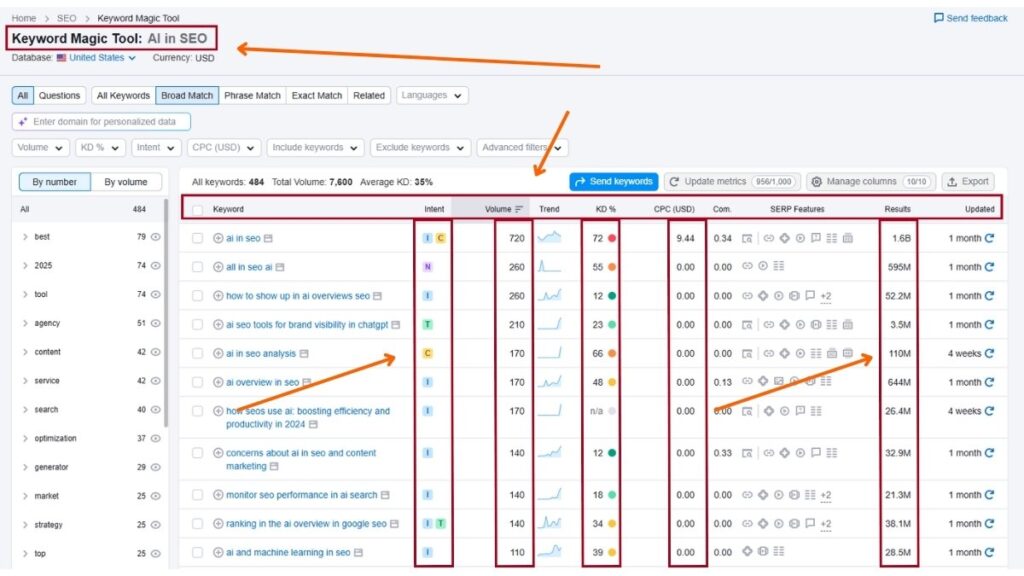
1. AI Keyword Research
Modern AI tools analyze:
- Search intent
- Keyword difficulty
- Semantic relationships
- Trending topics
- Question-based queries
Note:
“Instead of chasing single keywords, AI helps create topic clusters.”
Example workflow:
Main Topic: AI in SEO
Cluster Topics:
- What is AI in SEO
- Best AI SEO tools
- SEO automation tools
- Future of SEO
- Generative engine optimization
A blog using this cluster strategy built topical authority and started ranking for multiple related keywords instead of just one main keyword.
“This builds topical authority.”
2. AI Content Creation
AI tools assist with:
- Blog outlines
- Content drafts
- Headline suggestions
- FAQ sections
- Meta descriptions
However, AI-generated text should always be refined by humans. Adding examples, real insights, and experience improves quality and trust.
In one test, two similar articles were published:
one directly generated by AI and another manually edited with examples and improved readability. The edited version achieved significantly better engagement and ranking within weeks.
“Google prioritizes helpful content, not automated bulk writing.”
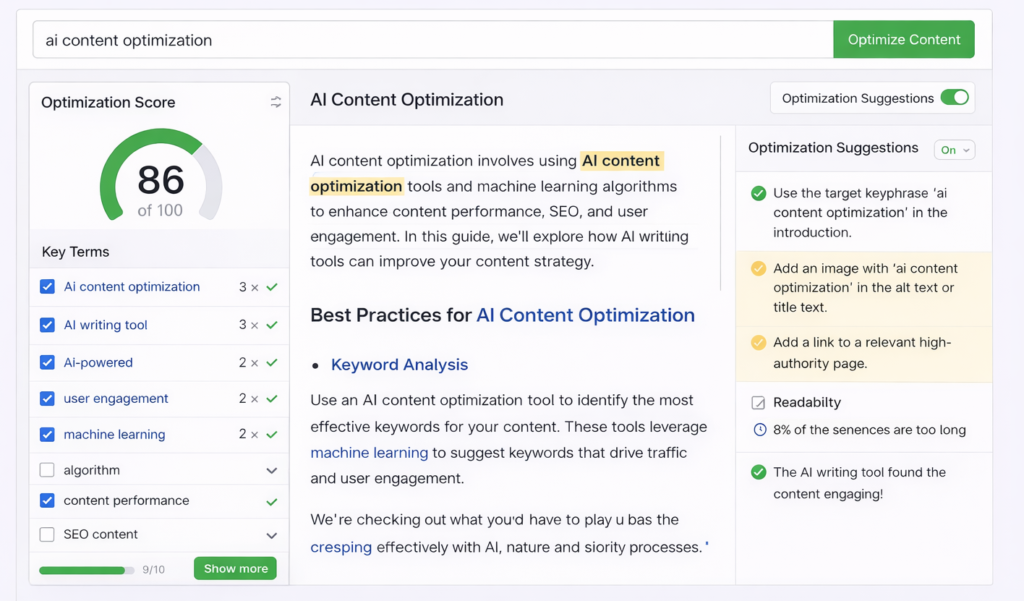
3. AI Content Optimization
AI tools analyze top-ranking pages and suggest:
- Semantic keywords
- Content length targets
- Header structure
- Internal linking opportunities
- Readability improvements
A blogger optimizing existing articles with AI-based content suggestions saw improvement in average ranking positions within a month without creating new content.
“This helps increase ranking potential without guessing.”
4. AI Technical SEO
Technical SEO is often complex. AI simplifies it by detecting:
- Broken links
- Crawl errors
- Duplicate content
- Speed issues
- Schema problems
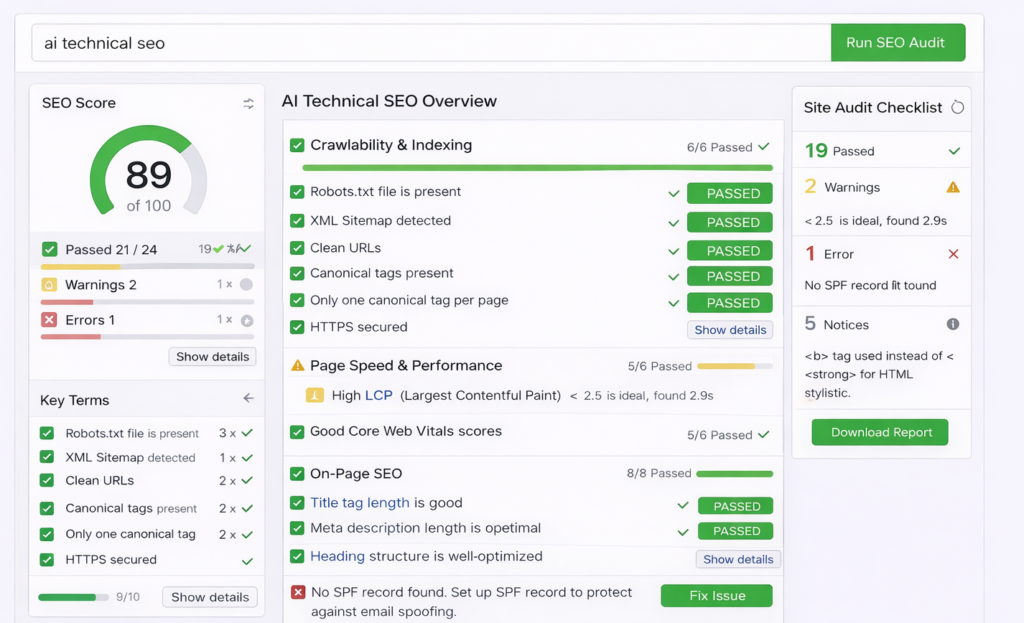
Automated technical audits have helped many website owners fix hidden issues that were affecting indexing and rankings for months.
“Automation reduces manual errors.”
5. AI Competitor Analysis
AI-driven competitor tools can:
- Track ranking keywords
- Analyze backlinks
- Identify top-performing pages
- Reveal content gaps
For instance, identifying competitor content gaps allowed one website to publish targeted articles that ranked faster due to lower competition and better intent match.
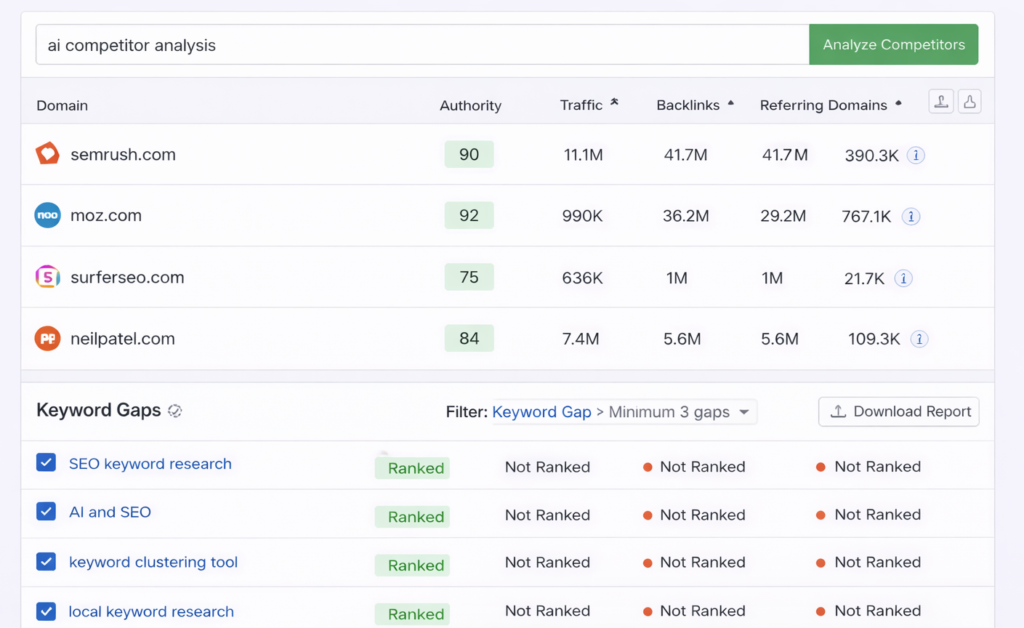
“This gives strategic direction instead of copying competitors blindly.”
How to Use AI in SEO (Step-by-Step Implementation)
Step 1:
Build an AI Keyword Intelligence System
Start with your “main keyword”.
Then:
- Generate related long-tail keywords
- Identify user intent
- Create topic clusters
- Analyze top competitors
- Identify missing subtopics
A structured keyword system ensures that every article supports overall topical authority instead of random publishing.
Step 2:
Create Structured Pillar Content
Your pillar page should:
- Cover the topic comprehensively
- Include FAQs
- Use short paragraphs
- Add clear subheadings
- Provide actionable steps
Then connect it with cluster blogs.
Websites using pillar + cluster strategy often see stronger internal linking signals and improved keyword ranking across multiple pages.
Step 3:
Optimize for AI Search
To make content AI-ready:
- Write clear answers
- Use structured headings
- Add FAQ schema
- Use conversational queries
- Focus on intent
Structured and well-formatted content is easier for AI systems to understand and feature in search results.
Step 4:
Implement SEO Automation
You can automate:
- Rank tracking
- Weekly SEO reports
- Technical audits
- Internal link suggestions
Automation saves time and improves consistency, allowing marketers to focus on strategy and quality.
Best AI SEO Tools in 2026
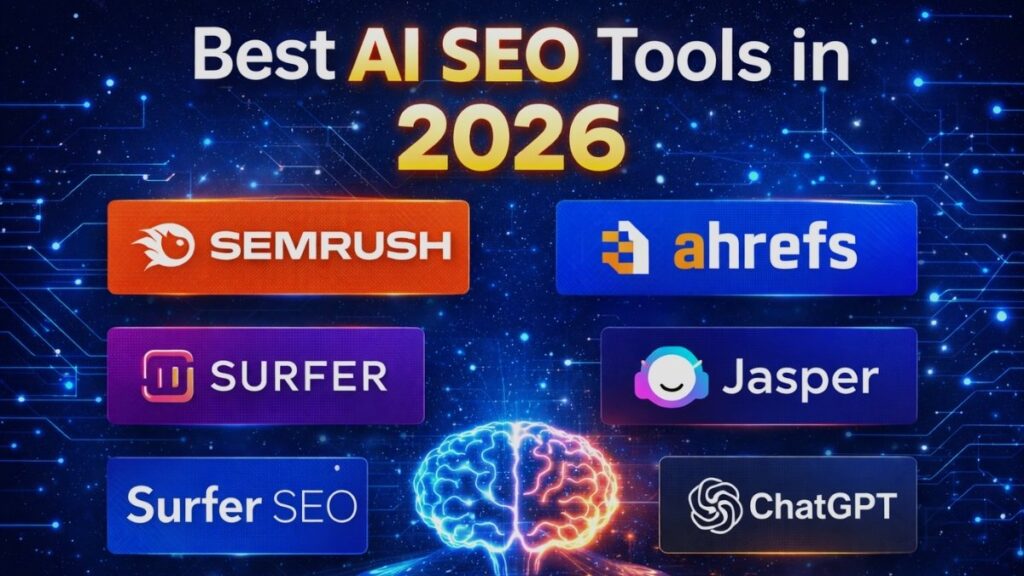
Reliable AI SEO tools used globally:
| SEMrush | keyword research and competitor analysis |
| Ahrefs | backlink and keyword intelligence |
| Surfer SEO | content optimization |
| Jasper | AI content assistant |
| ChatGPT | strategy, planning, workflows |
Note:
“Many SEO professionals combine multiple tools to create a complete optimization system rather than relying on a single platform.”
Best Free AI Tools for SEO Beginners
If budget is limited, start with:
Even with free tools, consistent publishing and proper optimization can generate steady organic traffic growth over time.
Generative Engine Optimization (GEO): The Future of SEO
Search is moving toward AI-generated answers.
Generative Engine Optimization means optimizing content to appear in AI-generated summaries.
To improve visibility:
- Provide concise definitions
- Add structured data
- Include FAQs
- Use clear language
- Build authority
Websites with structured and informative content are more likely to appear in AI-generated responses across modern search platforms.
Common AI SEO Mistakes to Avoid
- Publishing raw AI content without editing
- Over-optimizing keywords
- Ignoring search intent
- Not updating old content
- Relying only on automation
Websites that balance automation with human strategy consistently perform better in long-term rankings.
Note:
“Many SEO professionals combine multiple tools to create a complete optimization system rather than relying on a single platform.”
Expert-Level Strategies for Long-Term Growth
To build real authority:
- Publish comprehensive pillar content
- Create cluster blog architecture
- Strengthen internal linking
- Add real examples and insights
- Update content every 6–12 months
- Focus on user experience
Websites following consistent content + optimization strategy often see stable traffic growth rather than short-term ranking spikes.
“AI supports strategy — it does not replace it.”
The Future of SEO (2026–2030)
What to expect:
- Conversational search growth
- Personalized search results
- Visual search expansion
- Predictive SEO
- Authority-based ranking
Brands and creators who build trust and expertise will dominate search results in the coming years.
Conclusion: AI in SEO Is the New Standard
AI in SEO is not a temporary trend. It is the new foundation of digital visibility.
If you integrate AI into:
- Keyword research
- Content planning
- Technical audits
- Automation workflows
You will gain a major competitive advantage.
The future belongs to marketers who combine intelligence with strategy.
“Start today.”
FAQ Section
Q1. What’s the difference between SEO and AI SEO?
“Traditional SEO relies on manual methods. AI SEO uses automation and predictive analytics to improve efficiency and accuracy.”
Q2. How can I make content AI-ready?
“Use structured headings, FAQs, clear answers, schema markup, and intent-focused writing.”
Q3. Will AI SEO replace traditional SEO?
“No. AI enhances traditional SEO but human strategy and creativity remain essential.”
Q4. How to optimize for AI search?
“Write conversational content, use structured data, and build topical authority.”
Q5. What is generative engine optimization?
“It refers to optimizing content to appear in AI-generated search summaries and assistant responses.”
Q6. Top GEO strategies?
“Structured answers, FAQs, authority building, schema, and comprehensive coverage.”
About the Author
Aadil Khan is an SEO strategist and AI-driven digital marketing specialist with practical experience in building and ranking websites across multiple industries. He specializes in combining traditional SEO with modern AI tools to create high-ranking, user-focused content strategies.vvOver the past few years, he has worked on website optimization, content marketing, keyword research, and technical SEO projects where AI tools like Google Search Console, ChatGPT, and advanced SEO platforms are used to improve rankings, traffic, and user engagement. His approach focuses on real search intent, topical authority, and long-term organic growth rather than short-term tactics.